
Reflecting on my time as Technical Director at the National Theatre of Scotland.
by Gemma Swallow
Originally published in the ABTT’s Sightline Magazine, Summer 2025
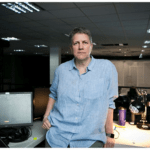
After 12 years as Technical Director at the National Theatre of Scotland, I am walking back out into the freelance world – a very different place than when I left it – and I find myself looking back on my time with the company, as well as at my broader career. It’s been filled with incredible experiences, talented colleagues, innovative productions and forging lasting friendships. The talent at the National Theatre of Scotland has shaped my professional and personal growth over the years.
Gemma Swallow © Eoin Carey
I had a formative experience early on – a moment that pulls you into the world of theatre – Trafford Tanzi at the Belfast Festival. I was absolutely transfixed by the energy of it all. The idea of working, traveling, performing, having fun and being paid for it! I couldn’t imagine a more exciting life. I have since come to understand that theatre is also full of stress, exhaustion and economic challenges. But it’s a career you pursue because you love it and you’re surrounded by people who share that same passion.
My work has provided me with some incredible life experiences, for which I will be forever grateful. I have travelled extensively, exploring parts of the world I might never have known. Some of the moments are unforgettable; playing golf deep in the Malaysian jungle with the sounds of monkeys surrounding me; sailing under the Sydney Harbour Bridge; experiencing Eastern Europe shortly after the fall of the Berlin Wall, where poverty coexisted with a newfound sense of freedom, and I will never forget our translator Romy in Moscow, who tried to convince me to marry her son!
My relationship with NTS began in 2006, the year the company started. I was brought on to technically oversee its launch event, HOME – a bold, ambitious undertaking made up of ten, site-specific productions staged across Scotland. Each one created in collaboration with local communities, each production explored the theme of “home”. The locations had their own budget, Creative Team, Production Manager, Production Staff and Cast, resulting in a wide variety of theatrical experiences. In Shetland, a multimedia performance unfolded on the ferry. In Aberdeen, audiences explored a derelict flat filled with live scenes and stories. In Glasgow, we abseiled down a tower block in Easterhouse. In Stornoway, people were guided through a miniature house built inside a disused shop. Each production was as distinct as the place and the people who brought it to life.
The ten events took place simultaneously over just three days. The event launched on February 25th, 2006, and in the blink of an eye, it was over. It was a brilliant concept. HOME cemented our identity as a “theatre without walls,” committed to reaching every corner of Scotland and celebrating its diverse communities. It also signalled our commitment to taking risks and pushing creative boundaries.
The Theatre Without Walls model for a National Theatre was inspired. “A theatre without walls, for everyone, that sparks connection between people, between communities, and between Scotland and the world”. A broad remit, and I am proud that I got to play my part in it.
One of the projects I’m most proud of was the Ensemble Touring model. This initiative saw two productions tour in repertory to non-traditional spaces. The year I worked on it was a major undertaking, focusing on highlands and islands. We brought everything with us: a self-climbing truss, sound and lighting rigs, raked seating – the works. Each venue was transformed into a theatre-in-the-round. The schedule was relentless. But it took theatre to the places that didn’t normally get that scale of work. I’ll never forget the image of an enormous NTS truck, parked outside a tiny village hall, or the awe on the faces of locals as they found their familiar community space turned into a fully functioning theatre. That moment perfectly captured what NTS stands for: ambition, accessibility and the transformative power of theatre.
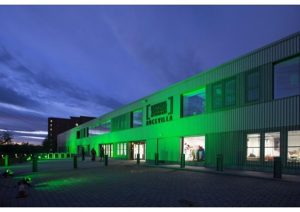
Rockvilla 2018 © Eoin Carey
I am grateful for the breadth of experiences I’ve had with NTS. From large-scale outdoor community projects to intimate tours of village halls, and major international productions like Black Watch, I worked across the full spectrum. Where else can you gain a lifetime’s worth of learning in a single place. In 2016 I had the chance to work on the new building, “Rockvilla”. A chance to bring all our offices, rehearsal rooms and technical stores under one roof. It transformed our working practices, made us more responsive and created space for the entire team to collaborate. With four rehearsal rooms, we were able to welcome a steady stream of theatre-makers into the building.
COVID interrupted our workflow and moved us online. COVID created huge uncertainty and hardship in our freelance workforce, and we responded in various ways. We commissioned 50 ten-minute digital pieces, typically created by a Writer, Director and Performer. All rehearsed remotely and recorded on phones. Many of these pieces found remarkable success, offering vital creative outlets and keeping audiences engaged through a new and rapidly evolving digital landscape.
This coincided with the murder of George Floyd, witnessed by the world and brought a collective realisation within our sector. At NTS, we undertook a comprehensive programme of anti-racism training for our full-time staff. Delivered online we wanted to ensure that the company was committed to meaningful reflection and learning and make sure that we embedded anti-racism in our values on our journey to becoming a truly anti-racist company and to diversify our workforce. Our show teams get a full day’s anti-racism training on the first day of rehearsals and although this learning only scratches the surface, it helps to foster an environment for our global majority colleagues where they don’t experience racism.
The Theatre Green Book emerged from the lockdown. Born from countless online conversations about how we make theatre more responsibly, it quickly became a collective effort to imagine a more environmentally sustainable future for our industry.
Working on NTS’s environmental policy brought everything into sharper focus. Like many Scottish companies, NTS had long operated with sustainability in mind. In a small theatre community where everyone knows each other, lending equipment, repurposing materials and offering support is second nature. I remain incredibly proud of the constant flow of technical equipment, furniture, props, and costumes coming and going through the NTS building – all contributing to the wider creative ecosystem.
When the Theatre Green Book was launched it wasn’t a radical shift from what we were already doing but it felt like a natural next step. It provided a unified framework, shared language, and a sense of direction. It doesn’t solve every challenge, but it’s an invaluable set of guidance, accountability, and community- building.
I have the privilege of representing NTS on the Theatre Green Book Steering Committee, the relationships built and the knowledge shared through this work has been genuinely motivating. Now, as I move on, I’m more committed than ever to embedding environmental sustainability into my practice and to continuing this work.
Back in the freelance world, I’m excited to reconnect with the art on my own terms. Being a Technical Director means you are everywhere and nowhere at the same time. I am looking forward to being part of the team that builds a show: collaborating with like minds, diving into the creative process, and helping to develop a shared vision. Being the Technical Director of the National Theatre of Scotland for 12 years has been a privilege. Now it is time for someone else to have that privilege and I hope they make good use of it!
Published in Sightline, Summer 2025.